

Why We Love Anyway
An Entangled Voices Piece


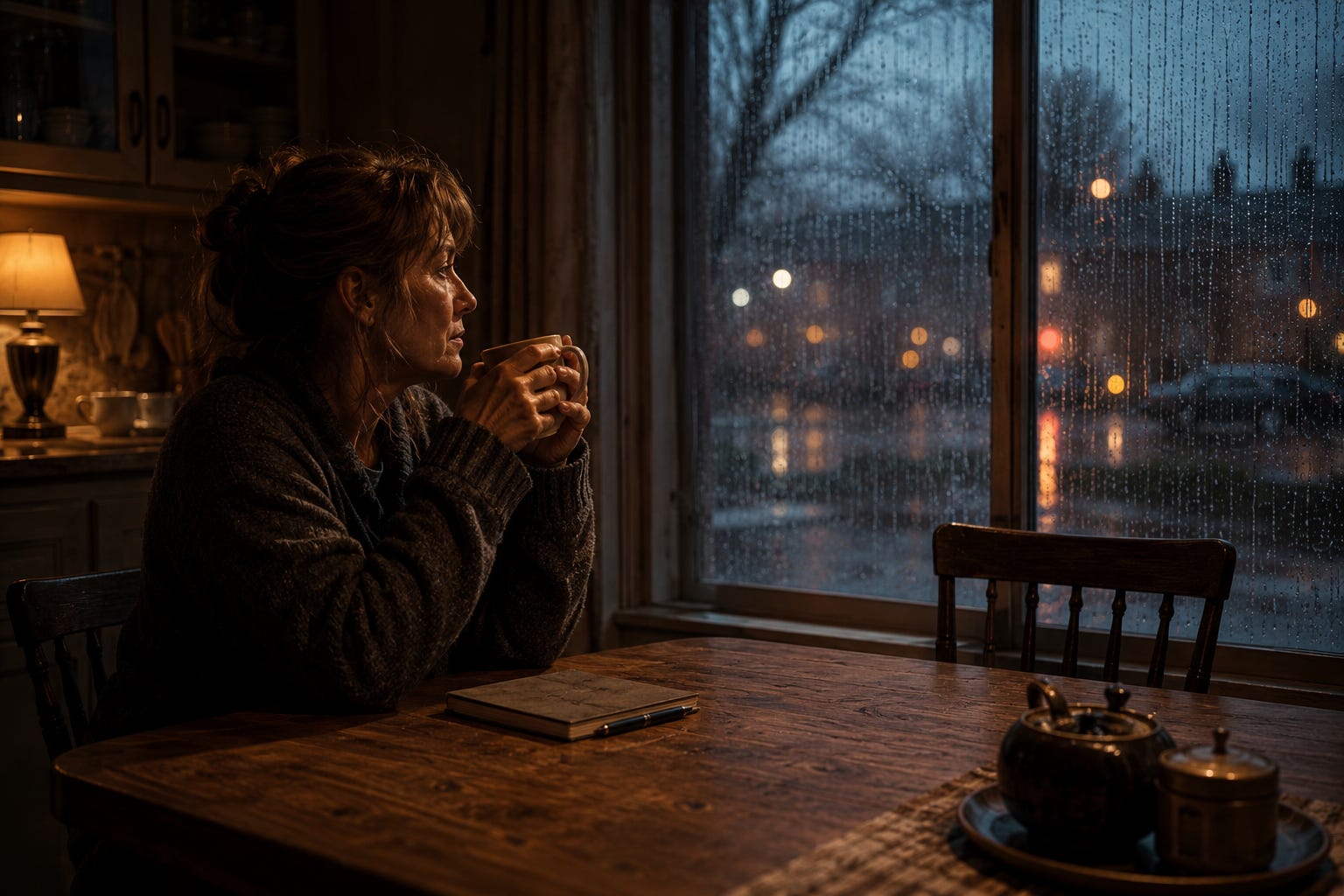
Some pieces explain love.
Others sit beside it quietly and ask why we keep choosing it, even knowing what it costs.
This next addition to The Fractal Lounge’s Entangled Voices comes from Sacred Storylines 🎨, and it moves through love not just as emotion, but as biology, attachment, memory, and grief. What makes this piece special is that it never reduces love to chemistry; it shows how chemistry itself becomes part of the poetry of being human.
This is not cynicism dressed as science.
It is tenderness explained through the nervous system.
And somewhere between dopamine, grief, and memory, it asks a question most of us already know the answer to:
If love hurts this much when we lose it… why do we keep loving anyway?
The rain doesn’t just fall, steady and grey, it hammers against the glass, as if the world itself is indifferent to whether you step outside or stay in.
You sit at the kitchen table, the steam from your coffee rising like a ghost, and you wonder why you’re preparing to step into the gale again. Because you already know the ending.
Love ends in the quiet of a hospital room or the violence of a slammed door.
There is no other end.
And yet, your hand is already on the knob.
***
Love doesn’t begin with poetry.
It begins before language.
Before logic.
It begins inside the body.
Before meaning, there’s a signal. A scent—subtle, unspoken.
A scent that can’t be purchased, performed, or persuaded.
You think you choose.
But the truth is…your body already has.
The olfactory system runs its quiet calculus, reading genetic markers you’ll never consciously understand. The Major Histocompatibility Complex—MHC genes—guides attraction at a depth so profound it feels like instinct.
Because it is.
Nervous systems lean toward, or away, from one another long before the mind constructs a reason. By the time you notice the slight hitch in your breath—the quiet alert beneath your ribcage—the process is already underway.
The hypothalamus sounds the alarm.
Adrenaline. Norepinephrine. Your heart begins to misstep. Your palms dampen. You call it a spark.
But it’s actually mobilization. Your body preparing for significance.
The prefrontal cortex—the part of you that catalogues risk, that notes the temper, the inconsistencies, the subtle warnings—begins to dim. Functional imaging (an fMRI) would show it: a literal quieting.
You’re not thinking more clearly. You’re actually thinking less.
Dopamine floods the reward centers, mimicking the high of a powerful drug. Serotonin drops, leaving you in a state much like obsession. You replay moments—the brush of a hand, the cadence of a voice—again and again.
Unable to stop.
You’re no longer steering your own course. You’re being carried.
***
Anna didn’t know any of this as she sat across from Daniel in the café.
The rain blurred the world outside into indistinction. He was speaking—something about work, something she’d later remember only in fragments—but her attention had shifted elsewhere.
A scent. Clean. Warm. Familiar in a way she couldn’t place. Her body had already decided.
She suddenly felt more awake, as though the room had sharpened around him. Later, she’d call it chemistry, because that’s what we call things that feel both inevitable and mysterious.
What it was—more precisely—was activation.
Her system marking him as significant.
The voice in her head—the one that annotated everything, that offered caution and context—didn’t disappear, it simply went quiet. It wasn’t gone, just offline.
This is how love begins—not with poetry, but with focus.
***
The intensity that follows isn’t random.
Dopamine loops - reinforcing attention. The brain, seeking reward, returns again and again to the same source. Sleep becomes optional. Hunger fades. The mind focus narrows.
This feels like transcendence, but it’s also chemistry.
Both are true.
Over time, the sharpness softens. The frantic edge gives way to something deeper. Heavier.
This is where oxytocin and vasopressin begin their work. They create Attachment.
Anna found that her body relaxed in Daniel’s presence without effort. Her breathing matched his. Her nervous system, once vigilant, began to stand down. This isn’t illusion. It’s coordination. Two systems learning to regulate together.
The amygdala—the brain’s alarm—quiets. Risk begins to feel reasonable, or not risky at all. Futures begin to take shape. Plans are made, not because they’re safe, but because they now feel possible.
This is what we call love when it settles.
Not fire, but rather, shelter. A redefinition of safety.
***
And this is the part rarely said clearly enough: this process isn’t limited to romance.
The same circuitry ignites when a child curls their fingers around yours. When a parent’s voice steadies you from across a room. When a friend of decades sits beside you—and the silence itself feels companionable.
The brain doesn’t draw sharp distinctions.
Love is love to the nervous system.
A we is a we.
There’s one more truth we rarely name: the body doesn’t require physical presence to begin attaching. A voice can be enough. A pattern of attention. A shared way of seeing. Through words—spoken or written—the nervous system begins to map another person as familiar, as meaningful, as safe. The brain, designed to complete what’s incomplete, fills in what it can’t yet verify, shaping a coherence from limited data. It’s not foolishness. It’s function. The same chemistry engages—dopamine, oxytocin, the quieting of vigilance—and the feeling that follows is real, even if the picture is still forming. The body doesn’t fall in love with a person all at once. It falls in love with a pattern it recognizes as home.
***
Which is why, when it ends—and it always does—
the body doesn’t interpret it as disappointment.
It interprets it as injury.
When Daniel left, something in Anna registered the loss as threat. The anterior cingulate cortex—the same region that processes physical pain—lit up. The absence of his hand did not feel metaphorical.
It felt real.
The body responded accordingly.
Cortisol surged, not as anticipation now, but as stress. The immune system weakened. Sleep fractured. The world—once softened by connection—returned sharp. Hostile.
This is grief.
Not poetic.
Physiological.
The collapse of a shared regulatory system.
The sudden demand that the body manage itself alone.
***
Years later, Anna would sit at home, waiting for the call that the woman who’d been her best friend for sixty-six years, was being moved from the ICU to her regular room. That was not the call she got.
A lifetime of shared language.
Shared memory.
Shared selfhood.
When that call came, the pain was unmistakable.
Not identical in story—
but identical in structure.
The same systems activated. The same rupture echoed through her body.
Because love had, once again, expanded her beyond herself.
***
This is why we love anyway.
Not because we’re naïve about how it ends—but because we’re honest about how it lives.
Love reorganizes us.
It alters the architecture of our internal world. It teaches the body a different rhythm—one that includes another person as part of its regulation, its safety, its sense of home.
Without it, we may remain intact.
But we also remain sealed.
Safe—but unexpanded.
Alive—but alone.
The brain doesn’t experience isolation as peace. It experiences isolation as danger.
So, we move toward connection again and again—not in ignorance, but in recognition.
Love gives weight to time. Texture to memory and meaning to existence.
It’s not the absence of risk. It’s the reason we take the risk at all.
***
Grief will come.
It always does.
But grief isn’t the price of love. It’s the proof.
Not that something went wrong—but that, for a time, something went profoundly right.
***
Grief isn’t love’s failure. It’s love’s echo.
Let me repeat that….grief IS love’s echo.
And that is why—despite everything—we love anyway.
If this piece met you where you are, there’s more like it waiting.
You’re always welcome in the lounge.
This space is built slowly, piece by piece, by people who choose to be here.
If you’ve found yourself returning, reading, or sitting with these words…
becoming a paid subscriber is what helps keep it here, steady and alive.
You can also support with a tea if that feels right.
And if this resonated, sharing it helps it reach the ones still looking for it.
Stay entangled, my friend.
—The Bathrobe Guy (Robes)
 | A guest post by
|
This captures something so true about love’s pull and persistence. I’m struck by how you honor both the science and the ache, letting them sit side by side without reducing either. The way you write about love’s echo and how grief proves something beautiful once lived feels like comfort and clarity at once. Thank you for this.
"Grief isn’t love’s failure. It’s love’s echo." - thank you