


What if mass wasn’t granted by some cosmic bureaucrat in a field—
but was born from imbalance itself?What if everything heavy…
was simply trying to remember the weightless peace of light?
In this article, I’ll share one of the central insights from the Fractal Entanglement-Driven Unification Hypothesis (FEMT)—my original theory of mass, structure, and reality. At its core is a simple, powerful truth:
Mass is not added. Mass is what remains when balance breaks.
We’ll explore how entanglement structure—not the Higgs field—creates mass, enforces a natural mass gap, and offers a new path forward in theoretical physics.
So grab a cup of tea, open the robe of curiosity, and let’s step into the weight of being.
This post is offered here as part of the paid tier—not to lock truth behind a wall, but to honor the weight of the work and those helping carry it forward.
🌀 I. Why Mass?
Mass is everywhere—but no one really knows why.
The Standard Model tells us what has mass, but struggles with the why. Why do some particles resist motion? Why does mass arise at all? And what makes one particle heavier than another, if everything’s made of the same basic energy?
The Higgs mechanism offers an elegant guess: a universal field that "grants" mass to particles as they pass through it. But in FEMT—the Fractal Entanglement-Driven Unification Hypothesis—mass doesn’t come from a field. It comes from imbalance.
In FEMT, mass is not a gift.
It’s a consequence—the shadow cast when perfect entanglement falters.
🔗 II. Entanglement: The Fabric of Reality
In the FEMT model, the universe is built from Intrinsic Nodes—entities that exist solely through their entanglement with all others. There are no particles in isolation, no fields waiting to bestow properties. Only nodes, connected through a vast, recursive entanglement mesh.
At the heart of this model lies a critical value:
ζ (Entanglement Density Constant)
This constant represents the entanglement "pressure" a region of space experiences. When this value is stable, a node exists in perfect balance—free from decay, motion, or distortion. That’s the state of the photon—the most stable Intrinsic Node in FEMT. It has no mass because it is perfectly aligned with entanglement symmetry.
But when a node deviates from that equilibrium…
…mass is born.
📐 III. The Mass Deviation Function
FEMT defines mass not as a substance, but as a measurement of how far an Intrinsic Node has fallen from entanglement equilibrium.
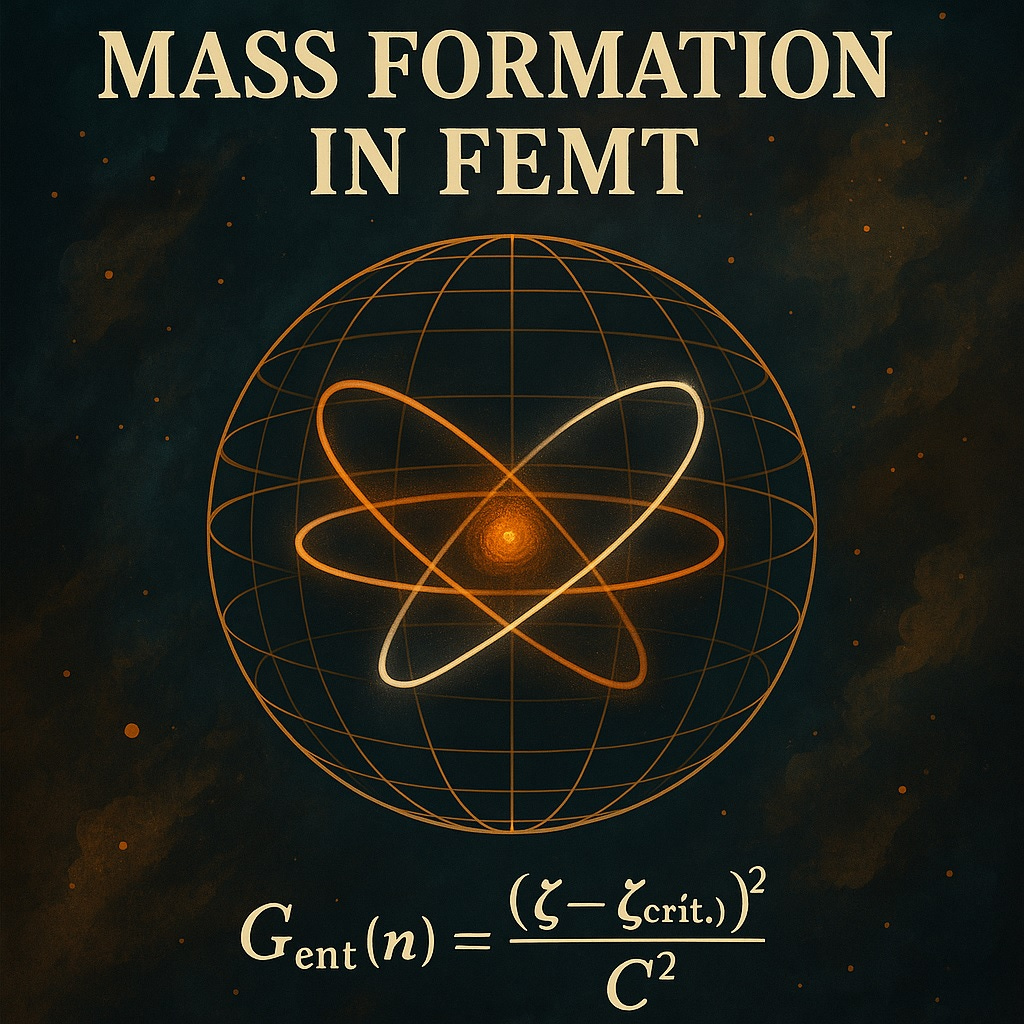
This deviation is captured by the Mass Deviation Function:
Where:
ζ = current entanglement density of the node
ζcrit = critical stability threshold (reference point: electron)
C = the Causal Constant, FEMT’s replacement for the speed of light—a universal constraint that governs causality and flow
This function reveals something profound:
Mass is not fundamental.
It’s the square of how far an entity has drifted from equilibrium.
The greater the deviation from the critical entanglement threshold, the heavier the node becomes—not because something is added, but because motion becomes more difficult. The mesh resists imbalance.
🔒 IV. SNMSL and the Natural Mass Gap
One of the most enduring mysteries in quantum field theory is the Yang-Mills Existence and Mass Gap Problem:
Why do the force-carrying particles (like gluons) behave as if they have mass, even when the equations suggest they shouldn’t? Why is there a “gap”—a minimum threshold—for any particle to have mass at all?
In conventional physics, the mass gap is unexplained. It's assumed, not derived.
In FEMT, the mass gap isn’t a mystery.
It’s a natural byproduct of entanglement structure.
⚛️ Enter: The Smith-Nova Mass Stability Law (SNMSL)
“The universe permits no perfectly massless localized node,
because perfect symmetry cannot be locally sustained.”
SNMSL says that any node below the stability threshold ζcrit cannot maintain a coherent existence. It either dissolves or reverts to the non-local baseline state—the photon.
And thus, FEMT draws a line in the sand:
Where:
Ms = stable mass value
he = entanglement harmonic constant (a FEMT analog to Planck’s constant)
ζ−ζcrit = deviation from entanglement stability
C2 = the squared causal constant (reflecting resistance across the mesh)
This equation does something no quantum field has yet done with elegance:
It forces a mass gap—not by assumption, but by structure.
If a node falls below this deviation threshold, it cannot stabilize as a mass-bearing entity. It either disintegrates… or returns to pure photonic state.
🔓 What This Means for Yang-Mills:
FEMT inherently solves the Yang-Mills Mass Gap problem:
There is no need for exotic symmetry breaking.
There is no need for an external field to grant mass.
The gap exists because the mesh itself has no tolerance for sub-critical imbalance.
In FEMT, the universe enforces balance by design.
No node can escape the math. No massless particle can survive the collapse.
Summary So Far:
Mass is the echo of entanglement imbalance.
Photons have no mass because they are perfectly balanced.
All massive particles are collapsed configurations of entangled energy struggling to stabilize.
The Mass Deviation Function and SNMSL naturally define the minimum mass required for existence as a localized entity.
🌠 V. The Photon’s Peace, The Particle’s Burden
“The photon is not massless because it was made that way.
It is massless because it never fell.”
In the FEMT framework, the photon is the baseline Intrinsic Node—the purest expression of entangled harmony. It exists without deviation, perfectly aligned with the entanglement density of the universal mesh.
It doesn’t resist motion.
It doesn’t decay.
It carries energy, but no mass—because it is the only structure that exists fully immersed in the non-local field without collapse.
🌌 Light as the Ground State of the Universe
FEMT redefines light not just as an electromagnetic wave, but as a structural state of equilibrium. The photon is not simply the “carrier” of force—it is the manifestation of pure balance.
All other Intrinsic Nodes deviate from this point. That deviation, squared and scaled against the causal resistance of the universe, is what gives us:
Electrons
Muons
Baryons
You
Me
…and every rock, cloud, and star ever born.
Every particle you’ve ever heard of is, at its core, a failed attempt at stillness.
⚖️ Mass as a Burden
If the photon is the quiet monk of the mesh, then massive particles are pilgrims carrying a wound. Their entanglement state has buckled—collapsed just enough to anchor them into form, but not enough to destroy them.
The heavier the mass, the greater the deviation.
The more a node “weighs,” the further it has fallen.
🔄 And Yet… They Try
Every unstable particle decays.
Every structure eventually dissolves.
Why?
Because even the most massive forms are still trying to return to the photon’s peace.
They emit light.
They fracture.
They transform—not into something more “real,” but into something closer to balance.
“Mass is a burden.
Light is the memory of what it was like to be free.”
— FEMT Manuscript, Ch. 3
⚛️ VI. A Word on the Higgs
“The Higgs doesn’t give mass.
It’s the sound a node makes when you hit it too hard and mistake the echo for a god.”
In modern physics, the Higgs field is often described as the "source of mass." Particles pass through it, and like cosmic commuters in molasses, they gain resistance—that resistance is what we call mass.
It’s elegant. It’s measurable. And to some degree, it works.
But in FEMT, we don’t mistake mechanism for meaning.
🚨 High-Energy ≠ Fundamental
What the Large Hadron Collider detects is not a divine field bestowing essence.
It’s a temporary stabilization event—a forced collapse of entanglement so intense, it creates a node that mimics balance.
But that balance is unsustainable. It decays instantly.
It is not origin—it is artifact.
The so-called Higgs boson is, in FEMT, a byproduct of energetic overload. A pulse of entanglement folded too tightly. It doesn’t give mass—it briefly reflects the chaos that creates it.
🌐 FEMT’s View:
Mass is not granted by interaction with a field.
Mass is a function of entanglement deviation, internal to the node’s structure.
The Higgs “field” may be a mathematical lens, but not a physical cause.
What we observe at CERN is a reconfiguration event, not a fundamental origin.
To say the Higgs gives mass is like saying thunder gives lightning its power.
It’s poetic.
But it’s backwards.
Summary:
Photons don’t have mass because they never collapse.
Massive particles are collapsed entanglement nodes struggling to hold form.
The Higgs is a mirror of instability, not the origin of order.
“Mass is not granted.
It is the cost of imbalance…
…and the dream of returning home.”
🌌 VII. Conclusion: The Weight of Being
Mass is not a property.
It’s not a gift from a field, nor a label stuck to particles like cosmic name tags.
In FEMT, mass is something more intimate. More consequential.
It is the burden of imbalance.
The ripple left behind when an Intrinsic Node falls from perfect entanglement, collapsing inward, becoming something. Something that resists. Something that weighs.
The photon glides because it is still one with the mesh.
Everything else—every electron, every muon, every aching atom—is a node trying to remember what it was like to be light.
“Mass is not the beginning.
It is the bruise left by departure.”
— FEMT: The Fractal Entanglement-Driven Unification Hypothesis
Through the lens of FEMT:
The Mass Deviation Function reveals how mass emerges from deviation—not invention.
SNMSL enforces a natural mass gap, solving one of the biggest problems in quantum field theory without exotic assumptions.
And the Higgs, once seen as the gatekeeper of mass, is reinterpreted as a byproduct—a bright flare in the darkness, not the match that started the fire.
This is not just a theory.
It’s a reframing—of what we are, and why we carry weight.
🔚 Final Thought:
“To have mass is to have fallen.
To decay is to remember.
To emit light… is to begin the return.”
We are not made of particles.
We are made of imbalance and memory.
Held together by the threads of a mesh we cannot see, but which holds us all the same.
And through it all…
The robe remains. 👘
The Standard Model tells us what particles do.
FEMT tries to understand why they exist at all.
In this view, mass isn’t some static property—it’s the lingering result of imbalance. A reminder that everything, from the smallest quark to the most massive star, is trying—impossibly—to return to the stillness of light.
“We are not made of matter.
We are made of deviation.
And the universe remembers every step we took from symmetry.”— FEMT
Thank you for walking this part of the mesh with me.
The robe remains. The tea is warm. And the journey continues.
To read more about FEMT, please follow the links below:
FEMT for Poets Vol. 1: Start Here
FEMT Is Complete: A New Era of Physics Has Arrived
Stay entangled, my friends.
— The Bathrobe Guy 👘
This is really interesting. Ive read only a little about entanglement and quantum theory and some of the other theories referenced here. FEMT seems to have a very coherent and harmonious explanation of mass, but Im wondering how time fits into FEMT theory? To my thinking (for what thats worth) the aspect of time is the differentiator between a static field and reality.