

The Forgotten Bell That Changed Navigation
Robe-Wrapped Moments in History — Vol. 11

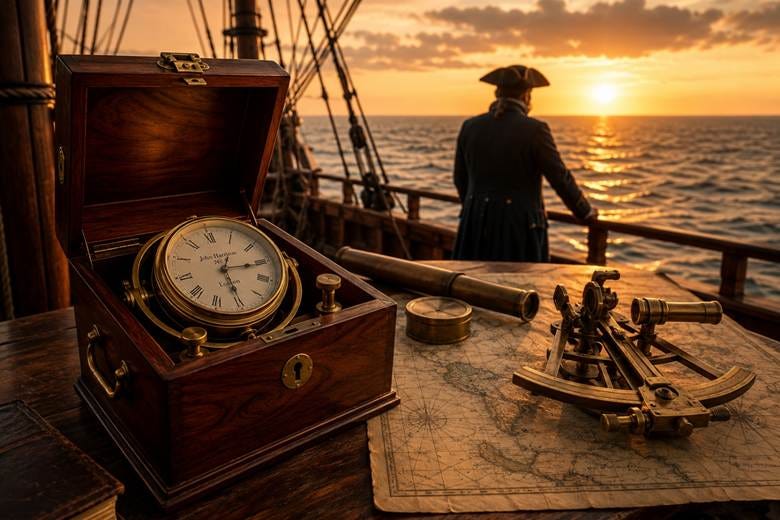
Sometimes history remembers the destination and quietly forgets the journey that made it possible.
This week’s Robe-Wrapped Moment in History is the story of John Harrison, a self-taught carpenter whose remarkable clocks solved one of the greatest problems in navigation. It is also a reminder that sometimes finding our way has less to do with seeing farther, and more to do with carrying one steady thing through a changing world.
Sometimes the hardest thing to find is not the destination.
It is your own position.
Most of us have experienced it, if only briefly. Walking through dense fog where familiar landmarks disappear. Waking in a hotel room and needing a few quiet seconds to remember which city you’re in. Driving at night after missing a turn, certain you know where you are until the next road sign gently informs you that you do not.
It is a peculiar feeling.
Not panic, exactly. More a quiet uncertainty, the unsettling realization that confidence and accuracy are not always the same thing.
We like to think we know where we stand. We orient ourselves by familiar things. A mountain on the horizon. A church steeple rising above a town. A favorite coffee shop on the corner. The little landmarks that quietly reassure us we belong exactly where we think we do.
But take those away, and certainty begins to drift.
For thousands of years, the world’s oceans presented exactly that problem. Once land disappeared beyond the horizon, every direction looked remarkably similar. The sea offered few landmarks, and the sky, though beautiful, did not always surrender its secrets easily. A sailor might know where he had been. He might know where he hoped to arrive.
Knowing where he actually was...
That proved much harder.
History remembers the great voyages; the explorers who crossed vast oceans and redrew the maps of the world. We admire their courage, their endurance, and their willingness to sail toward horizons no one had ever crossed before.
What we sometimes forget is that many of them spent much of those journeys not truly knowing where they were.
And for centuries, one of the greatest challenges humanity faced was not crossing the ocean.
It was learning how to find itself upon it.
Once sailors lost sight of land, the world became strangely deceptive.
The sea offered movement, but very little certainty. Waves rolled endlessly beneath the hull. Clouds drifted overhead. The stars appeared each night, tracing familiar paths across the heavens, yet the ocean itself gave away almost nothing.
For centuries, mariners learned to estimate their position through experience. They watched the wind. They studied the currents. They measured the height of the Sun at noon and the stars after sunset. These methods were often remarkably effective, especially for determining latitude; how far north or south they had traveled.
Longitude was another matter entirely.
Knowing how far east or west you had drifted proved astonishingly difficult. A ship might believe it was safely approaching a harbor when, in reality, it was dozens of miles away. On an open sea, such an error was merely inconvenient. Near a rocky coastline, it could be catastrophic.
And often was.
Entire fleets disappeared. Merchant ships carrying fortunes in cargo struck reefs they never expected to encounter. Storms certainly claimed their share of vessels, but many ships were lost on calm days simply because their captains believed they were somewhere they were not.
The problem grew more urgent as exploration expanded. Nations depended upon reliable sea routes for trade, communication, and survival. Every voyage carried not only sailors but economies, supplies, and sometimes the fate of entire colonies.
Governments offered enormous rewards to anyone who could solve what became known as the longitude problem. Astronomers searched the heavens for answers. Mathematicians devised increasingly elaborate methods. Brilliant minds across Europe wrestled with the challenge for generations.
It seemed impossible that humanity could chart the stars, predict eclipses, and map entire continents...
...yet remain unable to answer one deceptively simple question.
Where are we?
As it turned out, the problem was never the ocean.
Nor was it the stars.
The problem was something far smaller, something nearly everyone carried with them every day without giving it much thought.
Time.
The solution, when it finally arrived, did not come from a famous astronomer.
It came from a carpenter.
John Harrison was born in Yorkshire, England, in 1693. He had little formal education, but he possessed something far more valuable for the problem before him; extraordinary patience and an instinctive understanding of mechanics. As a young man, he built clocks from wood, carefully shaping gears and mechanisms with remarkable precision. Long before anyone imagined he might change the course of navigation, he had already developed a reputation for building clocks that kept exceptionally accurate time.
At first glance, it seemed an unlikely place to begin.
After all, the world’s greatest scientists were searching the heavens for an answer. They studied the Moon, the planets, and the stars, convinced that somewhere above them lay the key to finding longitude.
Harrison looked somewhere much smaller.
He looked at a clock.
The idea itself was surprisingly elegant.
The Earth rotates once every twenty-four hours. That means it turns fifteen degrees every hour. If a sailor knew the exact time at a fixed location, such as Greenwich in England, and compared it to the local time aboard the ship, determined by the Sun reaching its highest point in the sky, the difference between those two times revealed the ship’s longitude.
An hour’s difference meant fifteen degrees.
Two hours meant thirty.
The mathematics were not especially complicated.
Keeping accurate time at sea was.
A pendulum clock, which worked beautifully in a quiet home, became nearly useless aboard a ship. Every wave altered its swing. Changes in temperature caused metal parts to expand and contract. Humidity warped materials. Salt air slowly worked its way into every mechanism. A clock that lost only a few minutes over several weeks could place a ship dozens of miles from its true position.
On land, that error might mean arriving late for dinner.
At sea, it could mean sailing directly into unseen rocks.
Most experts believed the challenge was simply too great.
Harrison disagreed.
Over the course of decades, he built a series of increasingly sophisticated marine timekeepers. Each improved upon the last. They were not merely smaller clocks. They were entirely new machines, designed specifically to resist the motion of the sea, the changing temperatures, and the relentless wear of long voyages.
His first designs were remarkable achievements, but he continued refining them.
Then came what became known simply as H4.
At first glance, it hardly looked like the massive clocks that had come before it. It resembled an oversized pocket watch, beautifully crafted and astonishingly precise. More importantly, it demonstrated something many had thought impossible.
It kept time.
Not perfectly.
Nothing ever does.
But accurately enough that sailors could determine their longitude with a precision that had never before been possible.
Even then, acceptance did not come easily.
The Board of Longitude, established by the British government to reward anyone who solved the problem, questioned Harrison’s work repeatedly. More tests were demanded. More demonstrations followed. Years passed before his achievement received the recognition it deserved.
Yet the results spoke for themselves.
Ships carrying one of Harrison’s chronometers could cross vast oceans with a confidence previous generations had never known. The stars had not changed. The sea had not become kinder.
Humanity had simply learned how to carry time with it.
And in doing so...
It had finally learned how to find its place upon the world.
It is tempting to think this story is really about clocks.
It isn’t.
It is about reference.
For centuries, sailors looked to the stars for guidance, and rightly so. The stars were dependable. The Sun rose and set with remarkable consistency. Nature had never stopped offering direction.
The difficulty was never finding something reliable to observe.
It was carrying something equally reliable with them.
The chronometer did not replace the stars.
It gave them something to compare the stars against.
That quiet difference changed everything.
Perhaps that is why Harrison’s invention feels so much larger than a beautifully engineered clock. It reminds us that understanding often comes, not from gathering more information, but from finding the right point of reference. The heavens had been telling the same story all along. Humanity simply lacked one steady voice with which to compare it.
The ocean had not become less mysterious.
The stars had not become easier to read.
The world itself had not changed at all.
Only the way people understood their place within it.
Sometimes the greatest breakthroughs do not arrive because reality becomes clearer.
Sometimes they arrive because we finally discover the one constant that allows everything else to make sense.
And once we do...
What once seemed impossibly confusing begins to feel almost obvious.
Perhaps that is why stories like John Harrison’s continue to resonate.
Not because most of us will ever navigate across an ocean using the stars.
But because we know what it feels like to drift.
Not always physically.
Sometimes inwardly.
There are seasons in life when familiar landmarks disappear. The routines that once grounded us begin to change. Relationships end. New responsibilities arrive. Certainties we carried for years quietly loosen their grip. We wake one morning realizing that the map we had been following no longer seems to match the landscape beneath our feet.
Our first instinct is often to search harder.
To gather more information.
To look farther ahead.
Yet Harrison’s story suggests something gentler.
Perhaps the answer is not always found by looking outward.
Perhaps it begins by finding something steady enough to carry within us.
The chronometer did not calm the waves. It did not shorten the voyage or remove the storms. It simply gave sailors one dependable reference that remained faithful while everything else continued to move.
There is quiet wisdom in that.
We often imagine stability as the absence of change. Yet the ocean never stopped shifting, and the sky never stopped turning overhead. The breakthrough came because one small instrument refused to drift along with everything else.
Perhaps our lives are not so different.
We cannot prevent change. We cannot keep every season from passing or every uncertainty from arriving. But we can choose the principles we return to. The values that continue keeping time even when everything around us feels unsettled.
Sometimes, finding our way has less to do with changing the world...
...and more to do with carrying one steady thing through it.
Today, most of us carry devices capable of telling us our exact location within a matter of feet. A phone quietly consults satellites orbiting thousands of miles above the Earth, and within moments we know where we are, where we are going, and how long it will take to get there.
It is an extraordinary achievement.
It is also one that rests upon centuries of quieter ones.
Long before satellites circled the planet, a carpenter sat patiently shaping gears and springs, convinced that time itself could become a guide. He did not calm the seas. He did not move the stars. He simply built something steady enough that others could find their place in a world that was constantly in motion.
Perhaps that is why John Harrison’s story still matters.
Not because most of us will ever stand on the deck of a ship searching for our longitude.
But because we all know what it feels like to lose our bearings from time to time.
Life has a way of changing the landscape beneath our feet. Plans shift. Relationships evolve. The future refuses to unfold according to our carefully drawn maps.
And perhaps in those moments, what we need most is not a clearer horizon.
Perhaps we simply need one faithful point of reference that refuses to drift.
The sea has never stopped moving.
Neither has life.
But every now and then, history reminds us that finding our way has never depended on stilling the waves.
Only on carrying something steady enough to navigate through them.
Thank you for spending another robe-wrapped moment exploring history with me.
The next time you find yourself checking a map or letting your phone quietly guide you home, remember that behind every effortless answer lies centuries of patient curiosity, careful craftsmanship, and people who refused to believe that “good enough” was the end of the story.
History, like life, is often less about discovering new horizons than learning how to find our place among them.
If this piece met you where you are, there’s more like it waiting.
You’re always welcome in the lounge.
This space is built slowly, piece by piece, by people who choose to be here.
If you’ve found yourself returning, reading, or sitting with these words…
becoming a paid subscriber is what helps keep it here, steady and alive.
You can also support with a tea if that feels right.
And if this resonated, sharing it helps it reach the ones still looking for it.
Stay entangled, my friend.
—The Bathrobe Guy (Robes)
This is a beautiful story, and a profound reminder. The distinction between looking outward for guidance and carrying something steady within is the difference between being lost and knowing how to find your way back.
What I find myself sitting with is the idea that the chronometer did not change the ocean or the stars. It gave sailors one dependable reference that refused to drift. That is what we are missing when we feel lost. Not a clearer horizon, but a steady point of reference within.
The line that stayed with me is: "The problem was never the ocean. Nor was it the stars. The problem was time." That is the quiet truth of it. We spend so much effort trying to read the world that we forget to carry something steady with us.
Thank you for this. It is a reminder that finding our way is not about controlling the waves. It is about carrying something that does not move.