

Gentleness
A robe-wrapped reflection on the quiet strength of meeting ourselves without force

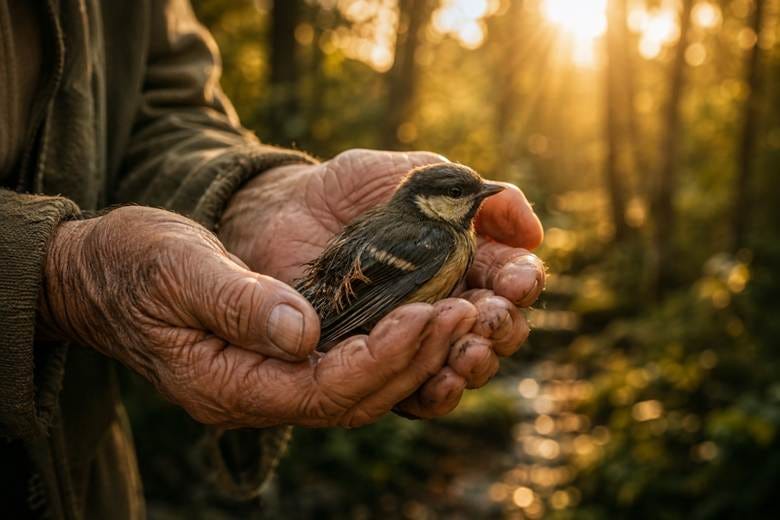
There are some kinds of strength that announce themselves immediately.
Others move so quietly through our lives that we hardly notice them at all.
This reflection isn’t about becoming softer in the ways we often imagine. It isn’t about avoiding difficulty or pretending life doesn’t ask hard things of us.
It’s about something much quieter.
The way we meet ourselves while we’re living through them.
There are certain things we instinctively handle with care.
A sleeping child.
A bird resting quietly beneath a hedge.
An old photograph whose edges have begun to soften with time.
A favorite mug with a small crack running along one side.
We don’t have to remind ourselves to be gentle with these things.
Our hands simply know.
There is something within us that recognizes fragility and responds without needing to be taught.
Perhaps that is what makes it so curious that we often become the one exception.
We make allowances for strangers that we refuse to make for ourselves. We understand when a friend is tired. We offer patience when someone we love is grieving. We tell them to rest. To take their time. To be kind to themselves.
Then we return home, make a small mistake of our own, and speak to ourselves in ways we would never dream of speaking to another human being.
It happens so quietly that we may not even notice it anymore.
A sentence under our breath.
A disappointment carried longer than it needs to be.
The quiet assumption that we should have known better, done better, become better by now.
Not because we are cruel.
Simply because, somewhere along the way, we began believing that gentleness was something meant for everyone except ourselves.
Perhaps we confused it with weakness.
Perhaps we imagined that if we eased our grip for even a moment, we would stop growing altogether.
But I wonder if the opposite might be closer to the truth.
If gentleness has never been the absence of strength...
but one of its quietest expressions.
Most of us do not wake up one morning and decide to become hard on ourselves.
It happens gradually.
A disappointment that lingers a little longer than it should. A mistake that is met with criticism instead of understanding. Expectations, spoken or unspoken, that quietly teach us our worth is something to be earned rather than received.
Over time, those moments begin collecting.
Not loudly.
Not dramatically.
Just enough that, eventually, a familiar voice begins following us through ordinary days.
It comments on the forgotten appointment.
The awkward conversation.
The project that didn’t turn out the way we hoped.
It reminds us of all the things we should have done differently, all the places we should be by now, all the ways we imagine we have somehow fallen behind.
It is such a familiar companion that we often stop recognizing it as a voice at all.
It simply begins to sound like the truth.
Perhaps that is what makes it so difficult to question.
We assume that if we stopped speaking to ourselves this way, we might become careless. Less responsible. Less motivated. As though kindness would somehow weaken our resolve instead of strengthening it.
And so we continue.
Correcting.
Judging.
Pushing.
Believing that constant pressure is simply part of becoming a better person.
Not because we enjoy it.
Because we quietly mistake it for discipline.
Yet I find myself wondering whether there is another possibility.
Whether the voice that keeps us moving is not always the one that helps us grow.
Whether some of the hardest journeys in life ask less for relentless criticism than they do for patient encouragement.
Because there is a quiet difference between someone walking beside you...
and someone standing behind you, never allowing you to forget that you stumbled.
And perhaps our hearts have always known which companion they needed.
There is a curious idea that runs quietly through much of our lives.
If we want to become better, we assume we must become harder.
Harder on our mistakes.
Harder on our weaknesses.
Harder on the parts of ourselves that have not yet become what we hoped they would.
We speak of growth as though it were something forced into existence. Something that responds best to pressure. Push a little harder. Demand a little more. Refuse to settle.
Perhaps there are moments when that has its place.
But when I look at the living world, I notice something different.
A seed does not become a tree because someone shouted at it.
A child does not flourish because every misstep is met with criticism.
Trust does not deepen because it is demanded.
Even a wound closes, not because we command it to heal, but because the right conditions quietly allow it to.
Life seems to grow in response to care far more often than force.
That doesn’t mean growth is easy.
Trees still endure storms.
Children still experience disappointment.
Healing still asks for patience.
Gentleness has never removed difficulty from the world.
It simply changes the way life is allowed to unfold within it.
Perhaps we have mistaken relentless pressure for discipline because pressure feels active. It feels productive. It gives us the comforting sense that we are doing something.
Gentleness, by comparison, can seem almost passive.
Yet there is very little in nature that mistakes force for wisdom.
The gardener does not pull on the stem to make the flower bloom more quickly.
The sunrise is never hurried into the sky.
Even the changing seasons seem to understand that becoming has its own pace.
Maybe we do, too.
Maybe the parts of ourselves that are still growing have never needed harsher judgment.
Maybe they have simply needed the kind of patient care that allows living things to become what they were already reaching toward, one quiet day at a time.
Perhaps one of the reasons gentleness is so often misunderstood is that we confuse it with giving up.
We imagine a gentle person as someone who never says no. Someone who avoids conflict. Someone who simply accepts whatever life places before them without resistance.
But that has never seemed quite right.
There is very little that is passive about a river carving its way through stone.
Very little that is weak about a tree remaining rooted through another winter.
Gentleness has never meant the absence of strength.
Perhaps it is simply strength without hostility.
There are moments when gentleness looks like rest.
There are others when it looks like speaking honestly, even though your voice trembles.
Sometimes it means admitting you cannot carry everything by yourself.
Sometimes it means setting a boundary that disappoints someone you care about.
And sometimes, perhaps most quietly of all, it means allowing yourself to begin again without turning yesterday’s mistakes into today’s identity.
None of those things are easy.
They ask something of us.
Not force.
Presence.
There is a quiet courage in meeting ourselves without immediately reaching for judgment. In noticing disappointment without allowing it to become condemnation. In recognizing our imperfections without concluding that they diminish our worth.
Perhaps that is one of the strongest things a person can learn.
Not because gentleness removes responsibility.
It doesn’t.
We are still asked to apologize when we have caused harm. To learn from our mistakes. To keep growing into wiser, kinder versions of ourselves.
But perhaps growth has never required that we become our own adversary.
Perhaps the strongest hand is not always the one that grips the tightest.
Sometimes...
it is the one that knows when to loosen its hold.
I sometimes wonder if one of the simplest ways to notice how we speak to ourselves is to imagine someone we love standing where we are.
A close friend.
A child.
A partner.
Someone carrying the very same disappointment. The very same uncertainty. The very same quiet feeling that they should somehow be further along than they are.
Would we greet them with impatience?
Would we remind them of every mistake they had ever made? Would we tell them they should have known better, should have worked harder, should have become someone else by now?
Most of us wouldn’t.
Not because we are unwilling to tell the truth.
But because we understand that kindness and honesty have never been enemies.
We know instinctively that encouragement is not the same as indulgence. That compassion does not prevent growth. If anything, it often makes growth possible.
Yet somewhere along the way, many of us quietly accepted the idea that we deserved a different voice than the one we so freely offer others.
As though understanding was something to be earned.
As though gentleness had to wait until we finally became worthy of it.
I am no longer sure that it works that way.
Perhaps we do not become worthy of gentleness after we have finished healing.
Perhaps gentleness is one of the conditions that healing has been waiting for all along.
There is something quietly transformative about meeting ourselves with the same patience we would offer someone whose burden we could plainly see.
Not because our own burdens are smaller.
But because they are often the ones we have carried the longest.
And perhaps they have been asking, all this time, not for harsher judgment...
but for someone, even if that someone is ourselves, to finally sit beside them without trying to win the argument.
There may never come a day when gentleness feels completely natural.
Nor do I think there should.
Life has a way of stirring us. We become impatient. We become disappointed. We lose our footing for a while. There will always be moments when the old voice returns, convinced that criticism is the quickest path forward.
Perhaps that voice does not disappear.
Perhaps, over time, we simply stop believing everything it says.
There is something quietly freeing about that.
Not because we suddenly become fearless.
Not because we stop making mistakes.
But because we begin to understand that growth has never depended on constant judgment. It has always depended on our willingness to remain present with whatever life is asking of us now.
Gentleness does not remove grief.
It does not erase loneliness.
It does not undo regret or guarantee that tomorrow will unfold the way we hope.
It simply changes the way we carry these things.
Instead of meeting every difficult moment with resistance, we begin meeting it with a little more patience. A little more curiosity. A little less urgency to become someone other than who we are today.
And perhaps that is enough.
Not because we have finished becoming.
But because becoming has never really been the point.
Perhaps the quieter invitation has always been to walk through this life without making ourselves one more thing that needs to be overcome.
To discover that strength and gentleness were never opposites.
Only different expressions of the same steady heart.
Maybe gentleness begins in the smallest of places.
Not in changing the world.
Not even in changing ourselves.
But in the quiet moment when we stop asking ourselves to earn the kindness we have been willing to offer everyone else.
And perhaps...
that is where healing has been waiting all along.
Thank you for spending a little while with me in The Soft Machinery of Being Human.
If this reflection stirred something familiar, perhaps it wasn’t asking you to become a gentler person.
Perhaps it was simply inviting you to notice that you have always known how to be gentle.
And that maybe...
you deserve some of that kindness, too.
If this piece met you where you are, there’s more like it waiting.
You’re always welcome in the lounge.
This space is built slowly, piece by piece, by people who choose to be here.
If you’ve found yourself returning, reading, or sitting with these words…
becoming a paid subscriber is what helps keep it here, steady and alive.
You can also support with a tea if that feels right.
And if this resonated, sharing it helps it reach the ones still looking for it.
Stay entangled, my friend.
—The Bathrobe Guy (Robes)
Good reflections on the Art of Self-Care! What we can learn from our generosity to others and their likely foibles, can readily be applied as a model to ourselves. A lengthy, but definitely
positive reminder - Be Good to You!